
 Donate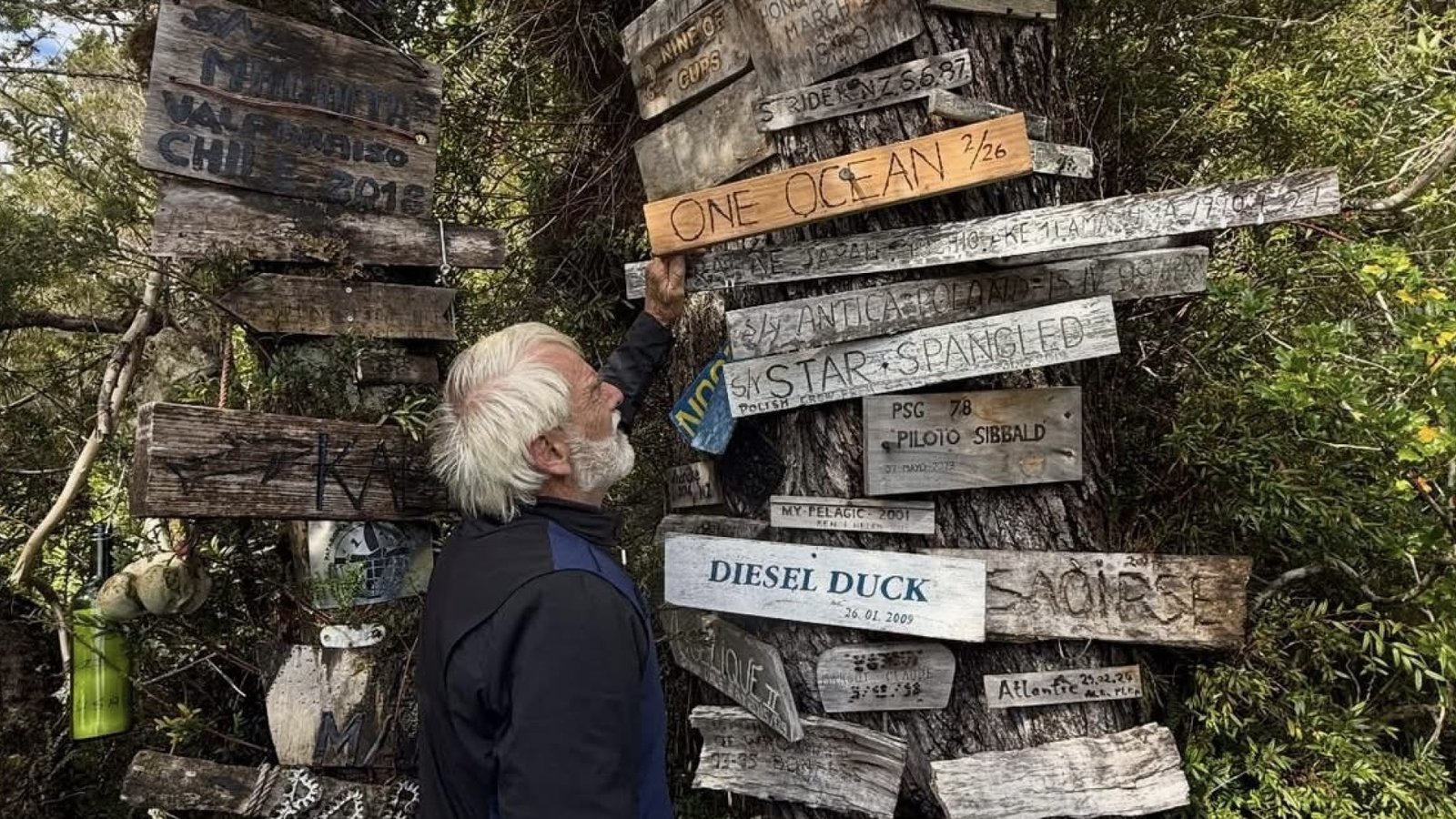
Sailing from Puerto Montt to the entrance of Penas is straightforward navigation-wise, not so much weather-wise. The channels, islands and hazards along this 120nm stretch are well documented and scenic. Protected from the prevailing westerly winds this leg of the voyage is relatively calm. The "reckoning" comes as the channels take you to the famed Golfo de Penas, wide open to the whims of the Southern Ocean.
Predominant conditions of this gulf are shaped by weather pushing ocean swells from the southwest into a 100nm opening where they are trapped in a deep bay surrounded by bold shorelines and big mountains. When the waves discover this trap they don’t appear to be happy about it and communicate this to anything in the way. Their uncompromising and powerful message is clear. As the swells, having just traveled thousands of miles over depths of 6,000 – 9,500 feet, encounter bottom depths decreasing to zero while colliding against big backstops (shoreline/cliffs/mountains) the results are spectacular (viewed from shore, cliffs or space) and uncomfortable to ride. For a truly chaotic experience add local wind and waves to the recipe. We’ve all seen the over-served party guy flailing his arms on the dance floor while enthusiastically dancing to the wrong rhythm - that's how the waves are moving. The Golfo de Penas is famous for this dance.
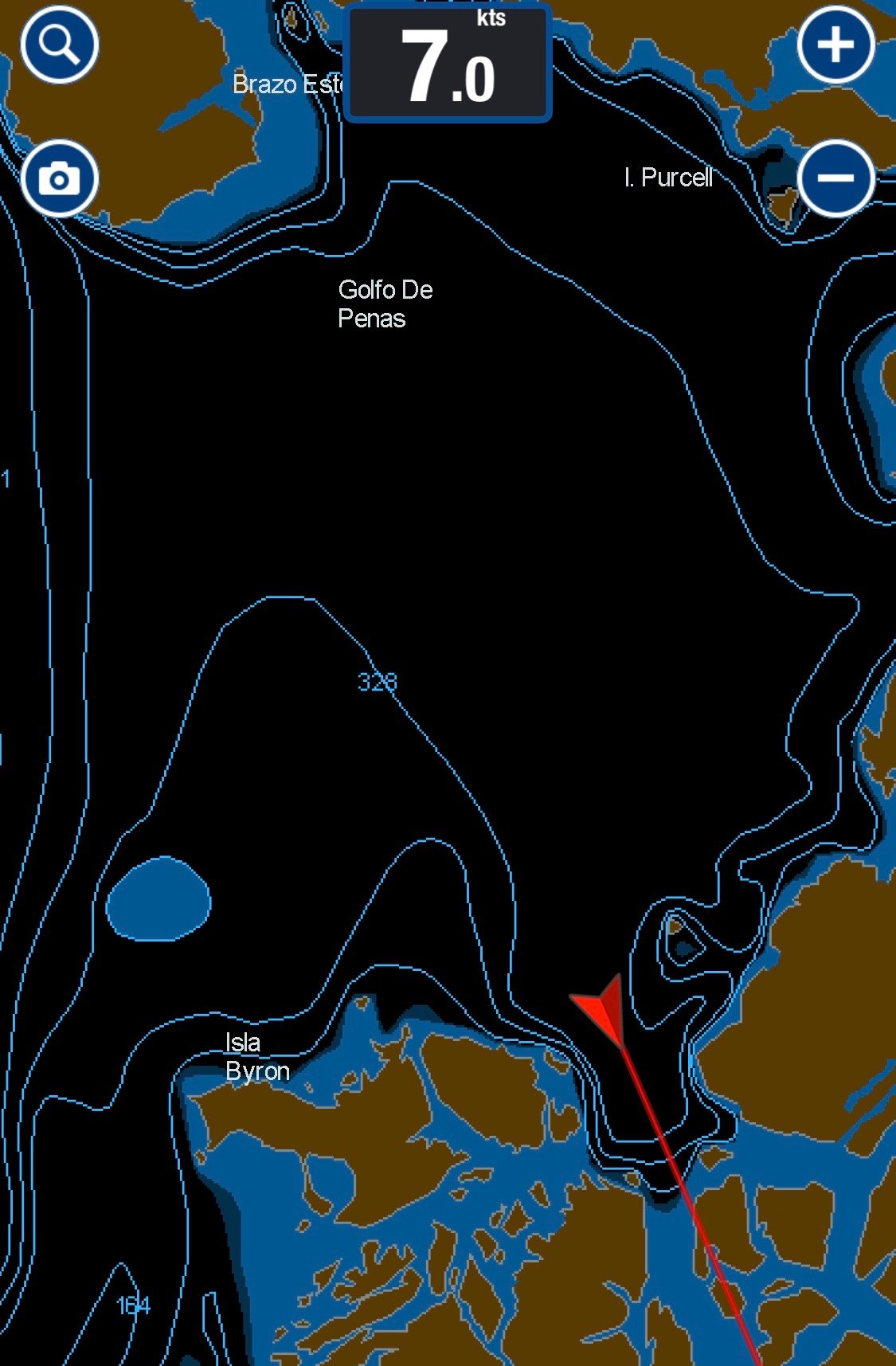
We have several books onboard about the Southern Chilean coastline and none fail to mention that ‘careful navigation’ is required in this area. Comparatively speaking, our southbound crossing was very similar to the northbound experience aboard Ocean Watch 15 years ago. A quote from our log entry, February 7, 2010, regarding crossing Golfo de Penas south to north; "some passages aboard Ocean Watch have been compared to being inside your home washing machine on the wash cycle. Apt comparison but last night we were in the industrial variety, long cycles and vigorous turbulent action. The spin and rinse cycles were less fun than the wash cycle." All aboard One Ocean agreed the description was apt. It wasn't comfortable!
We arrived at our chosen anchorage well after dark – and in this part of the world, dark is dark – no lights, no moon, no stars (overcast). Jenn navigated us to a recommended spot where we dropped anchor, shut off the engine after 80 hours of motoring and just listened – not a sound. It was as quiet as it was dark – extraordinary. Our position relative to the shoreline was a dot on a chartplotter, nothing visually available. Stand in the middle of a large, completely dark and unfamiliar room and decide what to do. We checked the anchor and retired to a warm, well lit cabin and celebrated our arrival in Patagonia. Others at this location had a very different experience. Dramatic and tragic maritime history surrounded us and our anchorage played an interesting role.
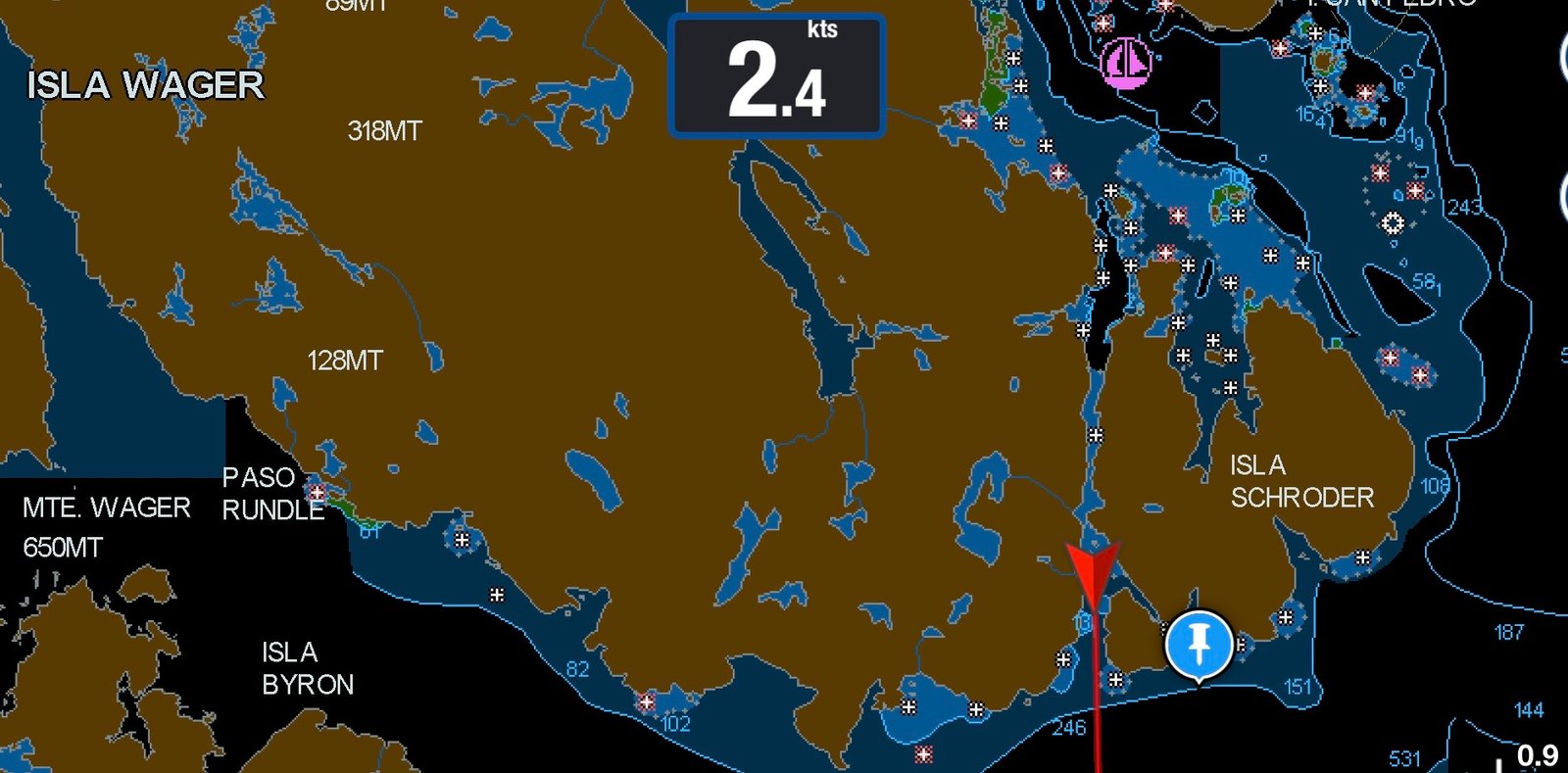
The name of the Island offering a safe cove to the cautious and weary traveller – Schroder Island. I had to smile, thinking that was probably a misspelling. Ocean Watch visited this island and anchored on the other side in a larger, more exposed bay. Not a great night 15 years ago. The islands around Schroder are named after sailors who experienced very difficult survival conditions. On May 14, 1741 the British bark, Wager, went aground on an island now named Wager Island, next to us! Surrounding islands were named from officers of that ship, which remains on the bottom of the north shore of Schroder, about a mile from where we anchored. The book WAGER, a “tale of shipwreck, mutiny and murder” is well researched and a very good read if you like dramatic Maritime history and are interested in what the Brits, Portuguese and Spaniards were quarreling over in that era. If that isn’t enough, our guidebook notes that Darwin was actually in the tiny bay we called home for the night and he climbed the low mountain right in front of us. I remember reading WAGER when we were in the arctic and noting that it all started with a shipwreck in Patagonia. We've just anchored in the middle of an amazing bit of history.
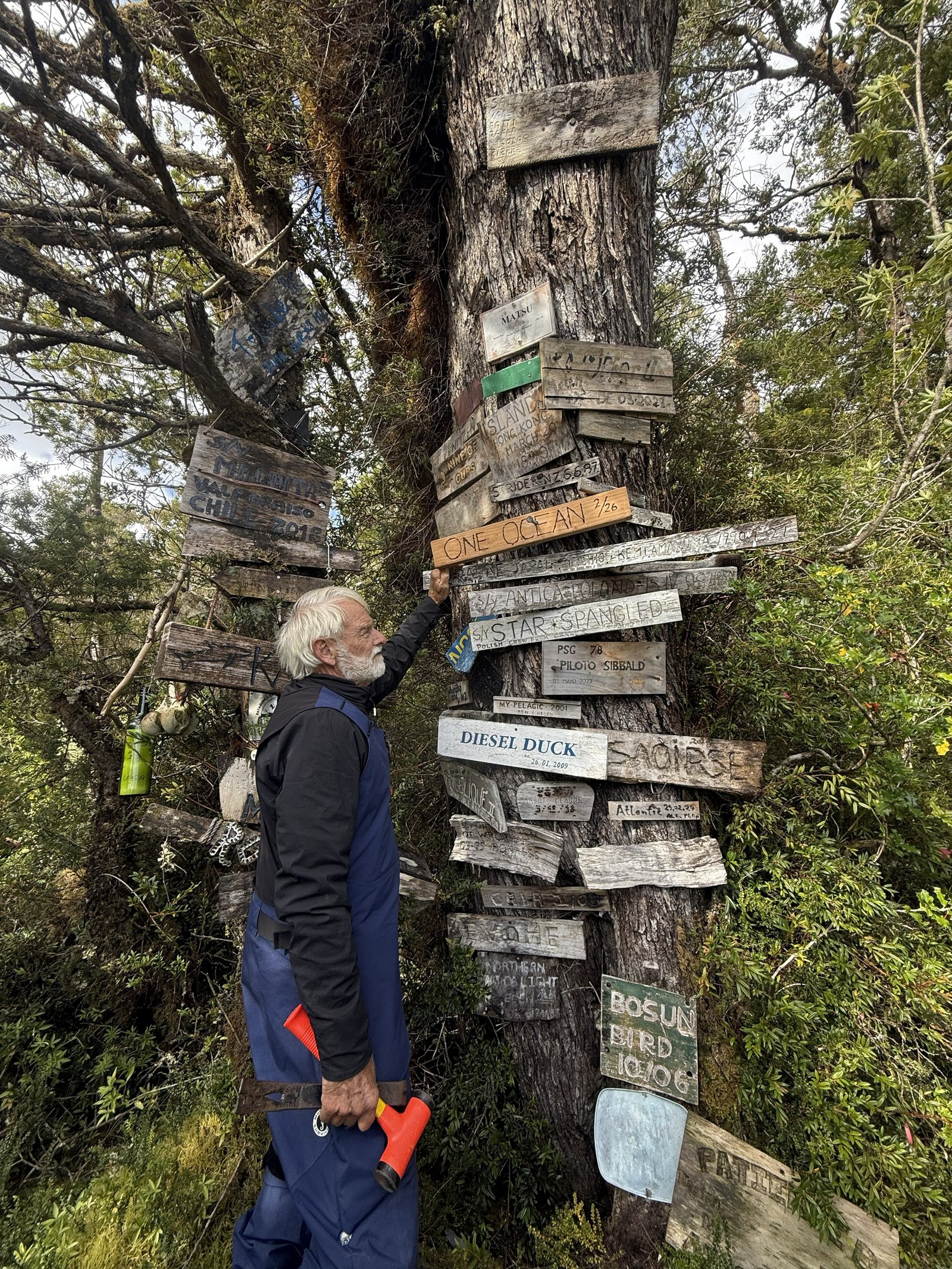
An old tradition amongst sailors in these waters is an 'arbol con tableros' (boards bearing ships names), as mentioned and practiced by Joshua Slocum during his voyage in the legendary Spray. A tall, partially dead hardwood tree at the end of Caleta Connor, our anchorage, was the obvious 'sign post' tree and displayed an impressive number of boat names painted or carved into odd bits of wood nailed to it. We decided to continue the tradition by adding One Ocean to the collection.
The scavenger hunt to find a suitable piece of wood to carve or paint, a spike or screw to secure it turned up a short length of 2x4 (part of the dinghy cradle) and a 10-inch galvanized spike (handy tent pin). Material found, now the art part.
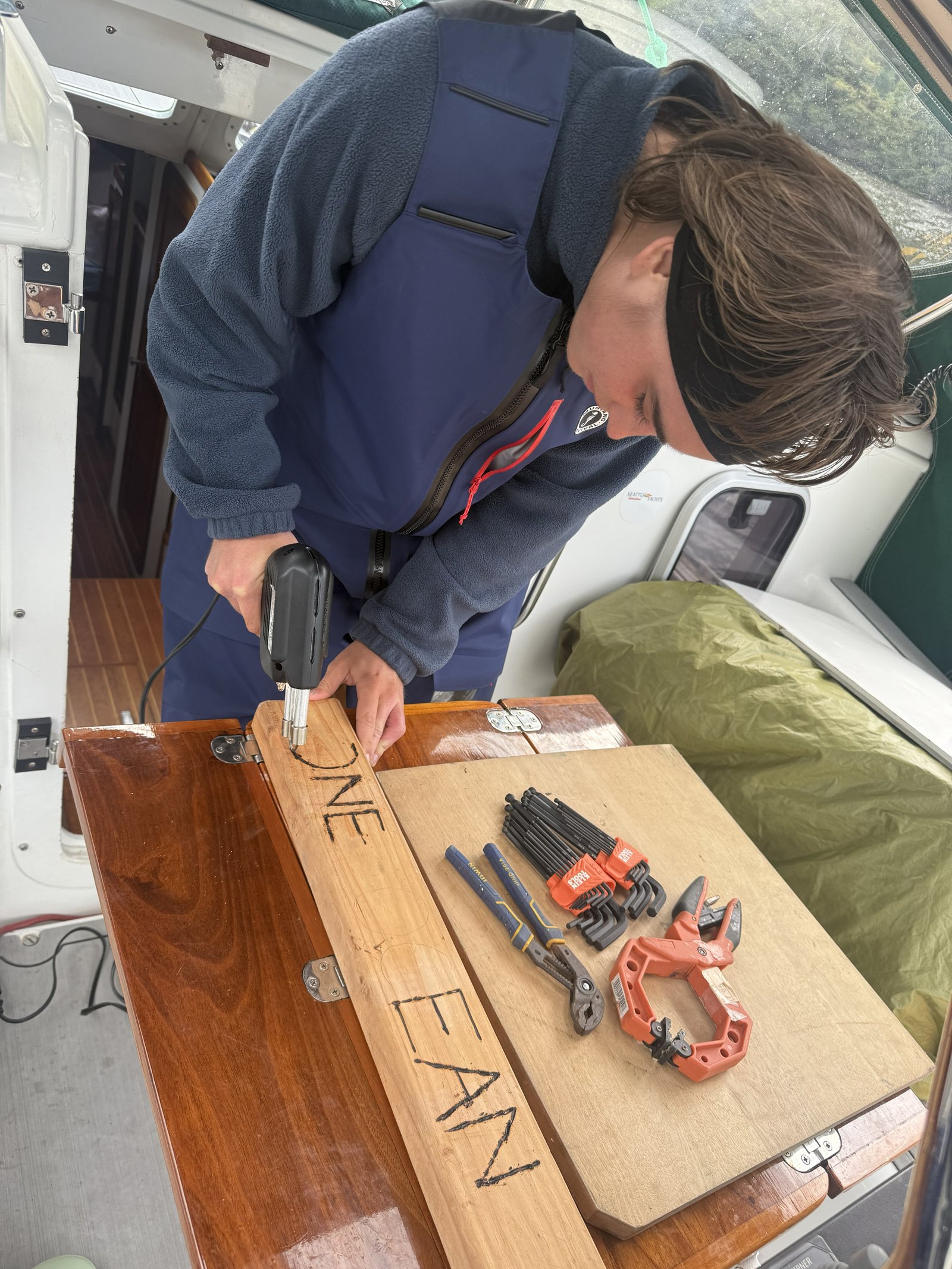
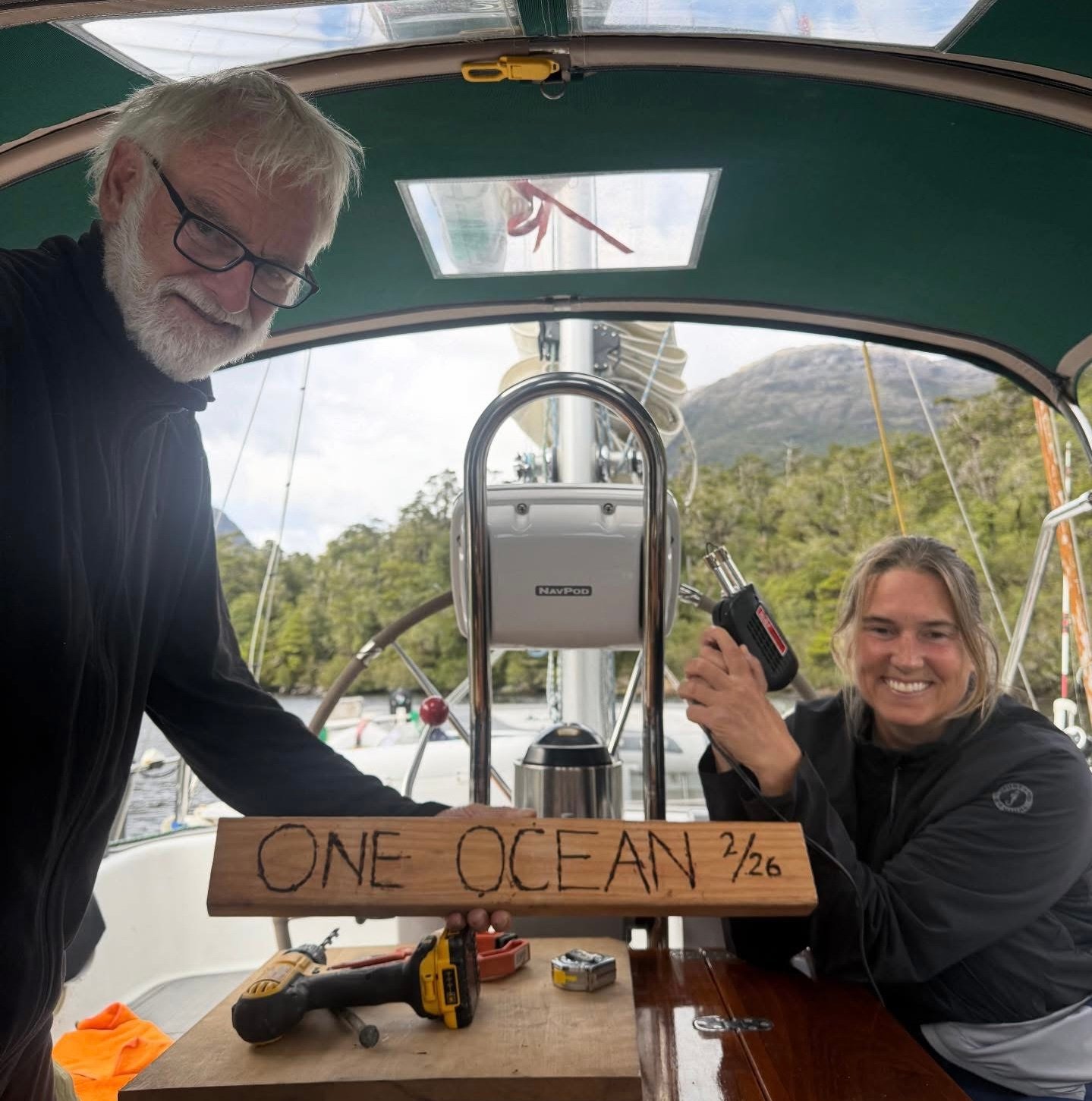
We turned our soldering iron into a wood burning tool, Tess laid out the lettering and Jenn attacked the outline with the woodburning soldering iron. Grace recorded the activity and I watched! Perfect onboard project while waiting for the wind and choppy bay to settle down.
Once the sign was done we gathered the pieces and a hammer and headed to shore. The tree trunk was about 20 feet above the water where waves were breaking on the only suitable landing spot. Tess and I were the shoreparty, Jenn and Grace handled the delivery. A quick survey confirmed the whole plan was a little sketchy. Very slippery rocks, a steep slope, lots of mossy brush and little breaking waves meant that Tess and I had to move quickly from dinghy to rocks to moss to tree trunk while Jenn kept the dinghy afloat and unharmed. Did I mention we were in a very isolated corner of Patagonia?
Expert dinghy maneuvering, quick moving by Tess, slower by me, landed us on the slippery shore with tools, sign and a rope. While scrambling behind Tess I noticed a very deep hole opening into the tundra - to be avoided! On the trunk of the tree was an impressive number of signs, nothing we noticed bearing Slocum's name but a variety and room for one more. The trunk of this large tree looked more rotten than healthy but as I started to drive the spike it proved otherwise. 10 minutes of pounding and 2" into the tree meant we needed different tools or a smaller spike. That meant a return dinghy ride. Our Uber driver wasn't happy.
Round two. Armed with a Dewalt drill, sign, rope and Tess, the effort was repeated. All went well until I found the hole in the tundra I'd warned everyone else about during our first ascent. It was surprisingly deep. The rope, Tess and my shoulders managed to stop my descent. Tools and body recovered, we positioned our sign, drilled a hole, pounded in the spike and admired our work. One Ocean will continue to 'represent' for as long as that tree stays standing. To celebrate the occasion we did what every sailor would do and enjoyed a small ration of rum!
It was now time to weigh anchor and head south. Comfortable, warm, dry and safe on the good ship Oo. The WAGER crew didn't have the same experience.